
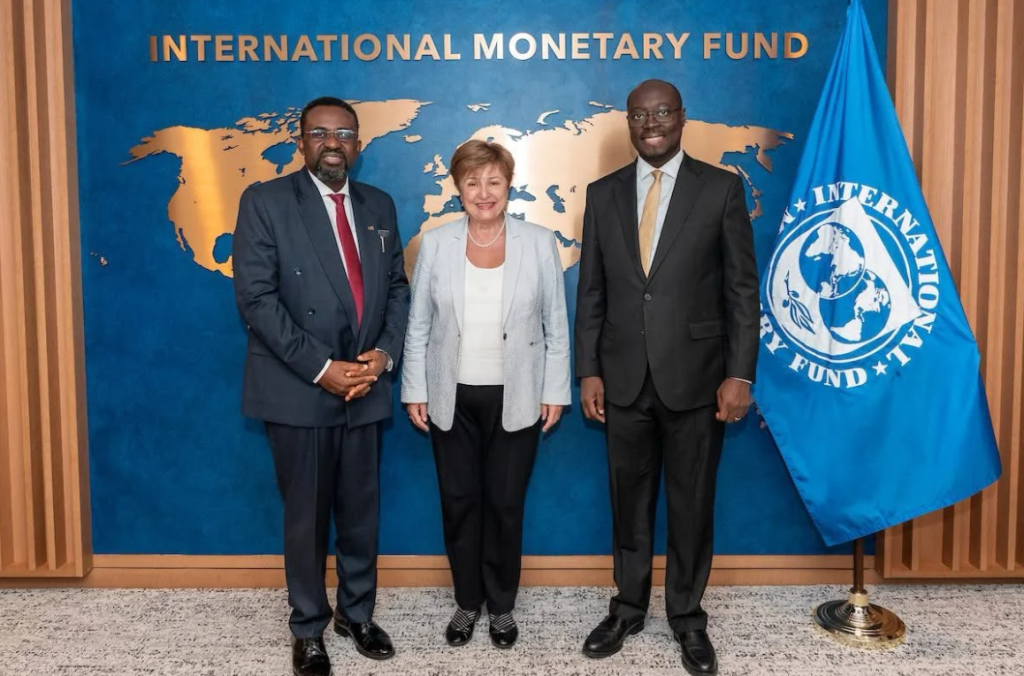
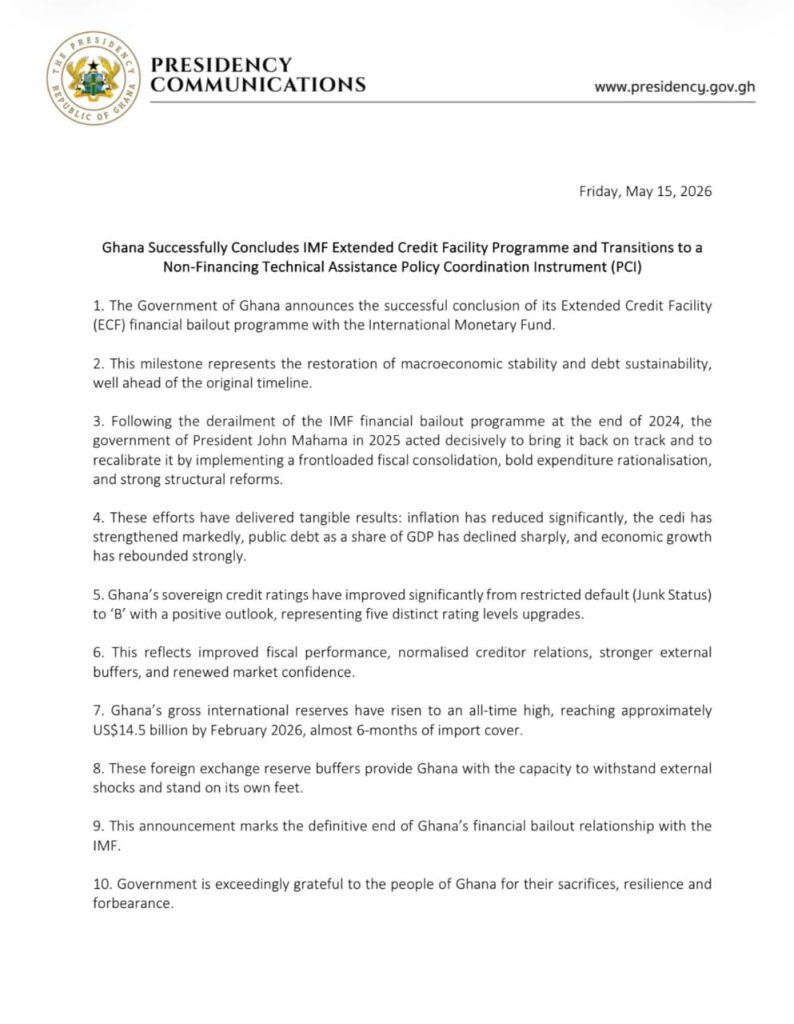
The Government of Ghana has officially announced the successful conclusion of its Extended Credit Facility (ECF) financial bailout programme with the International Monetary Fund (IMF), marking a significant milestone in the country’s economic recovery and fiscal stabilisation efforts.
According to an official statement issued by the Presidency Communications Office on Friday, May 15, 2026, the conclusion of the programme represents “the restoration of macroeconomic stability and debt sustainability well ahead of the original timeline.”
The statement further revealed that after the IMF programme experienced setbacks at the end of 2024, the administration of President John Dramani Mahama acted decisively in 2025 by implementing frontloaded fiscal consolidation measures, bold expenditure rationalisation, and strong structural reforms to place the programme back on track.
These reforms have reportedly produced remarkable economic results, including a significant reduction in inflation, a stronger Ghana cedi, improved fiscal performance, declining public debt-to-GDP ratio, and a rebound in economic growth.
Government also announced that Ghana’s sovereign credit ratings have improved substantially from Restricted Default (Junk Status) to a “B” rating with a positive outlook, representing five distinct rating upgrades. This development reflects renewed market confidence, improved creditor relations, stronger external buffers, and prudent economic management.
In another major achievement, Ghana’s gross international reserves reportedly reached an all-time high of approximately US$14.5 billion by February 2026, equivalent to nearly six months of import cover. The Presidency noted that these reserve buffers position Ghana to withstand external shocks and strengthen economic independence.
Importantly, the statement declared that this achievement marks “the definitive end of Ghana’s financial bailout relationship with the IMF.”
However, government clarified that Ghana will continue its engagement with the IMF through the Policy Coordination Instrument (PCI), a non-financing technical assistance framework designed to support economic reforms, strengthen policy credibility, attract private sector investment, and unlock fresh development financing opportunities.
Unlike the ECF programme, the PCI does not provide financial bailout support. Instead, it focuses on capacity building, policy coordination, market confidence, and assisting Ghana to achieve investment-grade status.
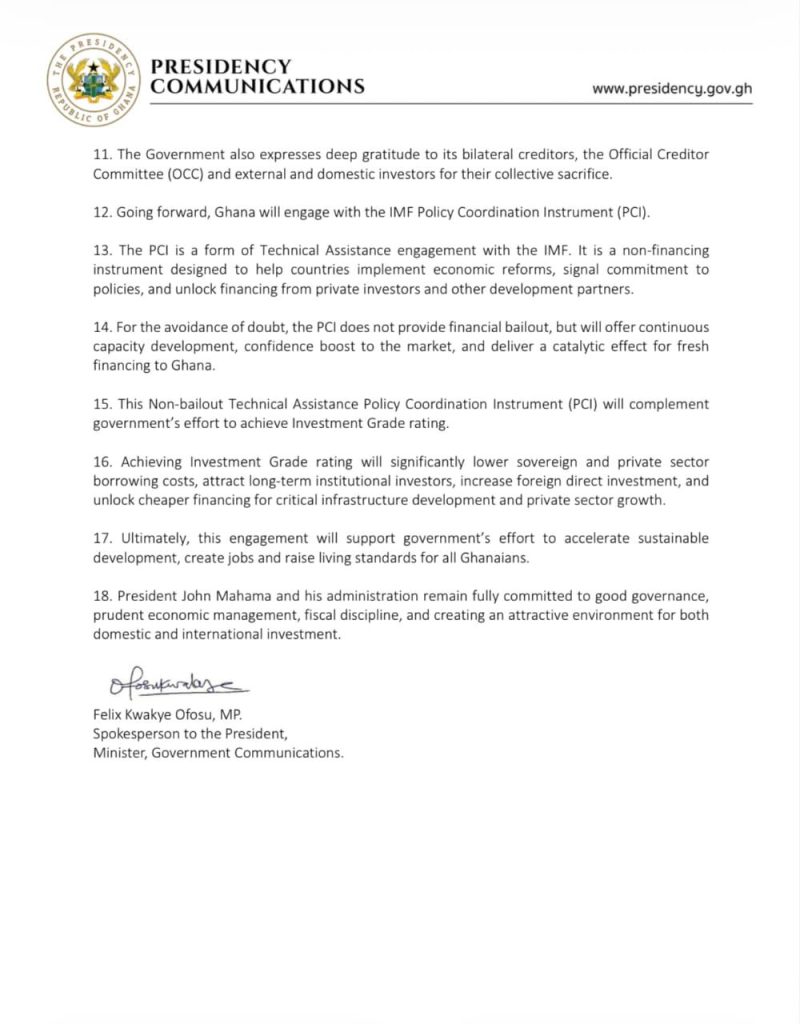
The Presidency explained that achieving investment-grade status would significantly lower borrowing costs for both government and the private sector, attract long-term institutional investors, increase foreign direct investment, and unlock cheaper financing for critical infrastructure development and private sector growth.
Government expressed profound gratitude to bilateral creditors, the Official Creditor Committee (OCC), domestic and external investors, economic experts, and the resilient people of Ghana for their sacrifices, patience, and collective commitment throughout the reform period.
The Ministry of Finance, under the leadership of Dr. Cassiel Ato Forson, together with the Bank of Ghana and the country’s economic management team, has been widely commended for steering the economy through difficult reforms toward renewed stability and investor confidence.
President Mahama’s administration reaffirmed its commitment to prudent economic governance, fiscal discipline, sustainable development, job creation, and maintaining an attractive environment for both domestic and international investment.
For many economic observers, a stable economy and a consistent national currency remain among the strongest indicators of long-term economic health, and recent developments suggest Ghana is steadily moving in that direction.
#Ghana #IMF #EconomicRecovery #FiscalDiscipline #JohnMahama #AtoForson #EconomicStability #ThisIsGhana #FinancialRecovery
Source: #DelaAkafiaNews #12FramesTvNews





4 Responses